
Same-Day Dumpster Rental Taunton, MA | Real Timelines
"Same-day" dumpster rental in Taunton is real, but it isn't automatic. Here's how order cutoffs, delivery windows, permits, and truck availability actually work.
ReadTaunton, MA guide
Shingles are heavier than they look, and a roofing dumpster sized on square footage alone almost always undersizes the weight allowance. Here is the square-and-layer math Taunton roofers and homeowners actually need before ordering a container.
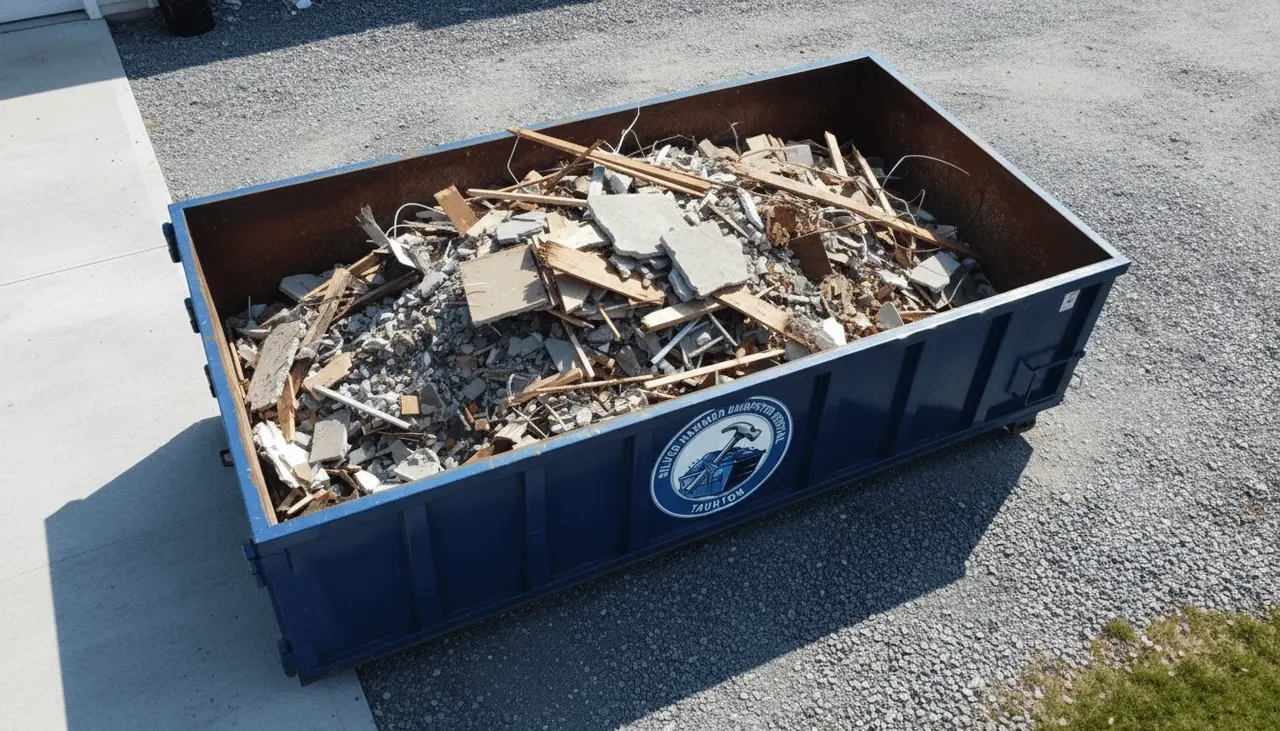
Ask most homeowners how big a dumpster they need for a roof tear-off and they will describe the house — two stories, mid-size, "not huge." That is the wrong starting point. Roofing is one of the only jobs where the container almost never fills up by volume before it maxes out on weight, and Taunton's mix of older triple-deckers, mill-neighborhood two-families and newer Silver City-area colonials all present the same basic math problem: asphalt shingles are dense, a full roof is measured in tons before it is measured in cubic yards, and the container that "looks about right" for the roofline is very often the wrong one for the scale.
This guide walks through the actual numbers — how much a square of shingles weighs, how single-layer and double-layer tear-offs change the math, why Bristol County winters shorten a roof's usable life and drive a disproportionate share of local tear-off calls into late winter and early spring, and how to match squares and layers to a 10, 15 or 20 yard container instead of guessing.
Roofers measure roof area in squares. One square equals 100 square feet of roof surface, so a 1,500 square foot roof footprint is roughly 15 squares (pitch adds a little more — a steep gable or hip roof can run 15 to 20 percent over the footprint measurement, which matters more than most people expect when sizing a container).
Shingle type changes the weight per square more than most homeowners realize. Standard 3-tab shingles are the lightest option still commonly found on older Taunton-area roofs. Architectural (dimensional/laminate) shingles, now the standard on most re-roofs, run noticeably heavier per square because they use more asphalt and a heavier mat. Add the felt or synthetic underlayment, drip edge, ridge cap and nails that come off with the shingles, and the real number for a tear-off always runs a bit above the shingle-only weight.
| Shingle type | Approx. weight per square (incl. felt & nails) | Single-layer, 1,500 sq ft roof (15 sq) |
|---|---|---|
| 3-tab (standard) | 200 – 250 lbs | ~1.5 – 1.9 tons |
| Architectural / dimensional | 250 – 400 lbs | ~1.9 – 3.0 tons |
| Premium / designer | 350 – 500 lbs | ~2.6 – 3.75 tons |
Two things push those numbers higher on a real tear-off. First, older roofing material absorbs moisture and holds granule buildup, so a 20-year-old roof coming off can run 10 to 20 percent heavier than a fresh bundle of the same shingle would suggest. Second, most Taunton-area homes are not single-layer anymore — which is where the sizing math actually gets interesting.
Massachusetts building code allows a maximum of two layers of asphalt shingles before a full tear-off to bare decking is required, and a large share of the triple-deckers and older colonials around Taunton, Raynham and Dighton were re-roofed once already — often over the original layer — before the current owner ever called for a quote. That means the roof crew is frequently pulling two full layers off at once, and the weight math does not just add, it roughly doubles.
A concrete example: a 1,500 square foot roof (15 squares) in architectural shingle runs roughly 1.9 to 3.0 tons single-layer, but the same roof torn off as a two-layer job can push 4 to 6 tons. That swing is the difference between a container that clears the job with room to spare and one that hits its tonnage allowance with the box still looking half-empty — which is exactly the trap this guide exists to help you avoid.
Roofing demand in Bristol County is not evenly spread across the calendar, and the reason is mostly weather. New England winters put roofs through a freeze-thaw cycle that milder climates simply do not see, and it is a real driver of why so many Taunton-area tear-offs get scheduled in late winter and early spring rather than staged evenly through the year.
Ice dams are the mechanism most homeowners eventually learn about the hard way. Heat escaping from the attic melts snow on the upper roof, the meltwater runs down to the cold eave overhang and refreezes, and a ridge of ice builds up at the edge. Once that dam forms, additional meltwater backs up behind it and works its way under the shingle layer instead of running off — which is exactly where asphalt shingles are not designed to shed water from. Repeated ice-dam cycles over several winters accelerate granule loss, loosen shingle tabs and seals, and soak the underlayment and decking underneath, all of which shorten the roof's usable life well below its rated number of years.
Wind-driven nor'easters add a second stress. Gusts can lift and crack shingle tabs that have already been weakened by ice-dam cycling, and repeated freeze-thaw movement in the decking underneath opens small gaps that let moisture in even on a roof that still looks intact from the ground. The net effect is that a roof in Taunton or Easton doing 20 years of duty has usually taken a rougher ride than the same shingle warranty would suggest in a milder climate — which is a big part of why so many local tear-offs turn out to be pulling damp, heavier-than-rated material, and why the "add 10 to 20 percent for an aged roof" adjustment above is not a hedge, it is realistic.
Volume and weight are two different limits on a roll-off container, and shingles are the material most likely to hit the weight limit long before the box looks full. Sizing a roofing job on cubic yards alone — "how big does the pile look" — is the single most common and most expensive mistake on a tear-off. The fix is to size by squares and layers first, and treat the container's footprint as a secondary check.
Three real-world examples make the pattern concrete. A 1,200 square foot single-layer ranch in 3-tab shingle — call it 12 squares at roughly 225 lbs each — lands around 1.3 tons, well within a 10 yard. A 1,800 square foot single-layer colonial in architectural shingle, about 18 squares at roughly 325 lbs each, runs closer to 2.9 tons and calls for a 15 yard. A 1,500 square foot double-layer triple-decker — a common Taunton scenario — can run 4 tons or more once both layers and aged-material weight are counted, which usually points to a 20 yard or a planned two-container swap rather than squeezing it into a 15. When you do not have an exact square count, describe the roof, the layer count and roughly how old the top layer is when you call — that combination decides the size far more reliably than square footage by itself.
A tear-off container is not limited to shingles alone. Felt or synthetic underlayment, ice-and-water shield, flashing, drip edge, ridge vent and any rotten decking the crew replaces along the way all travel with the load. Old gutters can generally go in too. The one thing worth watching is mixing in unrelated debris — construction scraps, old siding, or a garage cleanout riding along on the same container — because that eats into the tonnage allowance that should be reserved for the roofing material itself.
Some material categories are handled separately under Massachusetts' statewide waste rules rather than going in a standard roll-off at all — MassDEP maintains a list of items banned from disposal, including asphalt pavement, brick and concrete, which is a useful general reference if a tear-off also involves driveway or masonry work (see MassDEP's waste disposal bans guide). For a standard shingle tear-off this rarely comes into play, but it is worth flagging if the same container is being asked to also take concrete steps, an old chimney cap, or pavement debris.
Where the container sits matters almost as much as its size. Setting it on the tear-off side, close to the drop zone, saves the crew from carrying loaded tarps across a lawn or around a fence line all day — and on a weight-driven job like roofing, shorter carries matter more than usual because every trip is heavier. If the container needs to sit in the street rather than a driveway — common on tighter lots in older Taunton neighborhoods near the mill districts — check with the local Department of Public Works first; most Taunton-area towns require a permit for a roll-off placed on a public way, while driveway placement usually does not. Our roofing dumpster rental page has more on how we size and place these, and our same-day delivery service covers what to expect when a storm-damage tear-off needs a container fast.
Timing follows the weather more than most trades. Spring is the busiest local tear-off season as roofs that took a beating over the winter — ice dams, wind-lifted tabs, freeze-thaw cracking — finally get scheduled for replacement, and contractors working towns like Raynham, Easton and Mansfield often book several weeks out once the ground thaws. Booking the container early, and giving an honest square count and layer count up front, is the single best way to avoid a mid-job size swap.
If you are not sure which size your job needs, describe the roof — square footage, pitch, shingle type and how many layers are up there — and we will size the container and the weight allowance to match rather than guessing off the house. See our full size guide for dimensions across all five containers we run, browse the rest of our services, or get in touch for a same-day quote.
Talk to a real person
Call and describe the job. Flat price, stated tonnage, and a delivery time on the same call.
Mon–Sat 7:00am – 6:00pm · Sun by appointment
From this guide
It depends on shingle type and layer count more than square footage alone. A single-layer 1,500 sq ft roof (15 squares) in architectural shingle usually runs about 1.9 to 3 tons and fits a 15 yard container. The same roof torn off as a two-layer job can run 4 tons or more, which usually calls for a 20 yard or a planned two-container swap. Tell us the layer count when you call and we will size it correctly the first time.
Roughly 200 to 250 lbs per square for standard 3-tab shingles, and 250 to 400 lbs per square for architectural or dimensional shingles, including the felt underlayment and nails that come off with them. A 1,500 square foot single-layer roof in architectural shingle typically lands between 1.9 and 3 tons. Older, moisture-laden material can run 10 to 20 percent heavier than those baseline numbers.
Usually, yes. A second layer roughly doubles the tonnage rather than the volume, since the extra shingles compress into roughly the same pile. A lot of older Taunton-area homes were re-roofed over an existing layer at some point, so it is worth confirming the layer count before ordering — sizing off square footage alone is the most common mistake on a tear-off.
Yes. Underlayment, ice-and-water shield, flashing, drip edge, ridge vent, old gutters and any rotten decking pulled during the tear-off all load in with the shingles. What you want to avoid is mixing in unrelated debris from another part of the job, since that eats into the weight allowance that should be reserved for the roofing material.
Generally yes if the container sits on a public street or way — most Taunton-area Departments of Public Works require a street-occupancy permit for that. Placing the container in a driveway usually does not require one. Check with your town's DPW before delivery if a driveway is not an option on your property.
Keep reading
"Same-day" dumpster rental in Taunton is real, but it isn't automatic. Here's how order cutoffs, delivery windows, permits, and truck availability actually work.
ReadJunk removal gets it done the same visit; a dumpster rental lets you work at your own pace. Here's how Taunton homeowners should weigh cost, timeline, and labor between the two — and the hybrid option that combines both.
ReadTaunton sits at the junction of Route 24 and I-495, and the warehouses, business parks, and housing rising along that corridor bring a different debris problem than a kitchen remodel. Here's how commercial and industrial job sites differ from residential ones, and how a multi-container, scheduled-swap dumpster service keeps a busy corridor build on schedule.
Read