Heavy wet snow, downed limbs, and ice dam roof damage are a fact of winter in Bristol County. Here's how Taunton homeowners and contractors size and schedule a dumpster for nor'easter cleanup.
9 min readUpdated 2026-03-05By Silver Hammer Dumpster Rental
A Southeastern Massachusetts nor'easter rarely announces itself gently. The wind shifts out of the northeast, the temperature hovers right around freezing, and what starts as rain turns to a heavy, wet, cement-like snow that piles up fast. That kind of snow is the real culprit behind most winter storm damage in and around Taunton — it's not the cold that breaks branches and roofs, it's the weight. Understanding how that debris forms, and how to size a dumpster to clear it efficiently, makes the cleanup after the storm a lot less overwhelming.
This guide walks through the three debris types Bristol County homeowners deal with most after a winter storm — downed limbs and yard debris, ice dam and roof-related damage, and general storm cleanup around the property — along with how dumpster sizing and same-day availability actually work when a storm has just come through.
It's a pattern that repeats across the towns around Taunton every winter, from the low-lying stretches along the Taunton River to the higher, more wooded lots out toward Raynham, Berkley, and Dighton. Older neighborhoods near Taunton Green and the Whittenton and Weir sections tend to have more mature street trees, which means more limb damage in a heavy storm, while newer development along the Route 24 and I-495 corridors sees more roof and gutter damage on relatively young construction that still isn't necessarily built for a truly heavy wet-snow event. None of that changes the basic cleanup math much, but it does mean the mix of debris — branches versus shingles versus a bit of both — varies from one property to the next.
Why Nor'easters Hit Taunton Trees and Roofs So Hard
Taunton sits inland from Buzzards Bay and Narragansett Bay, close enough to the coast to catch the heavy precipitation bands a nor'easter wraps around its center, but far enough inland that precipitation often falls as wet snow rather than rain, especially in a shoulder-season storm in late fall or early spring. The National Weather Service forecast office covering Taunton is actually headquartered a few miles away in Norton (NWS Boston/Norton), and their winter storm warnings for Bristol County frequently note the difference between a "fluffy" snow event and a wet, dense one — the wet kind is the one that does the damage.
A cubic foot of dry powder can weigh under a pound. A cubic foot of wet, storm-driven snow can weigh several times that. When several inches of that snow accumulates on tree limbs that are still holding their leaves (common in an early-season storm) or on an older roof already carrying ice, the load adds up quickly. Add wind gusts on top of that weight and something gives — usually a weak limb, sometimes a whole tree, and sometimes the edge of a roofline where ice has already started to back up.
Downed Limbs and Yard Debris After the Storm
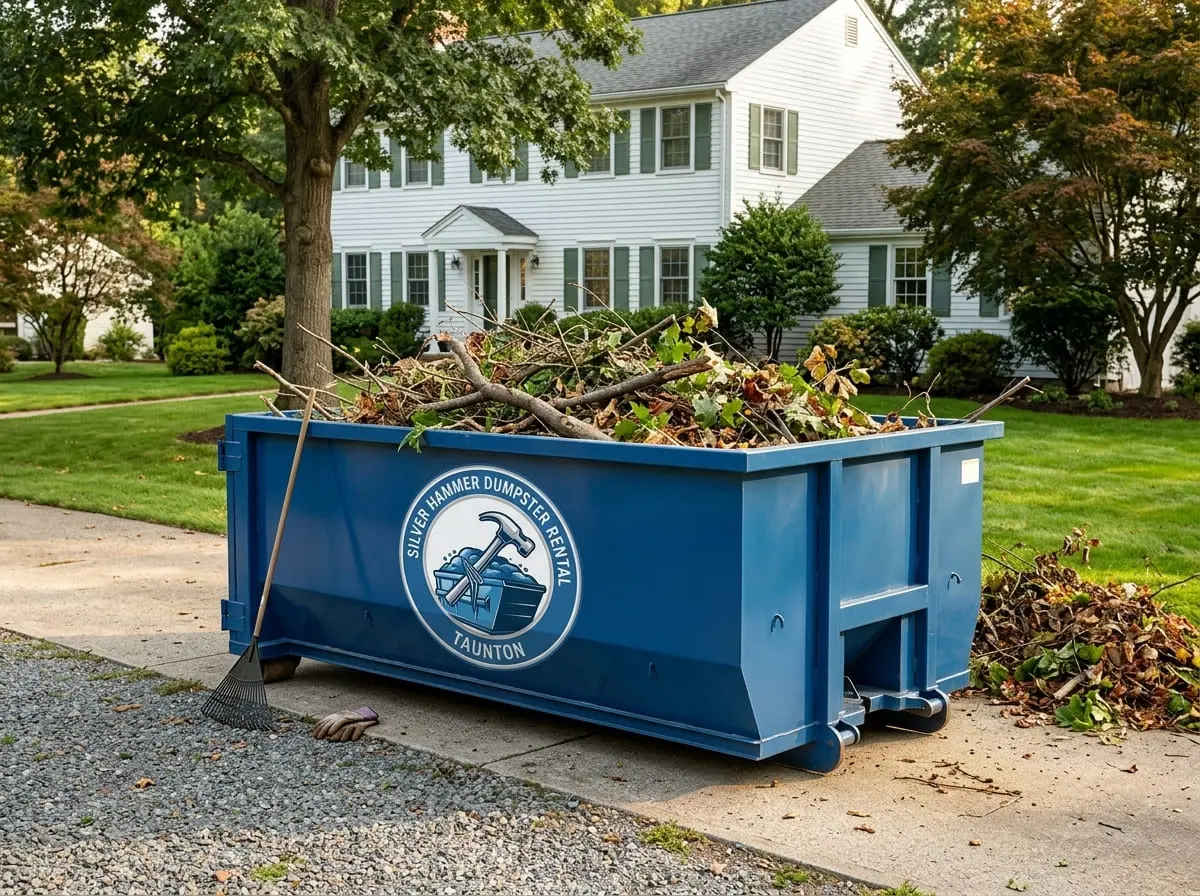
The most common cleanup job after a Taunton nor'easter is yard debris: broken branches, snapped limbs, occasionally a whole tree or a large section of one, scattered across a lawn, driveway, or fence line. A few things are worth knowing before you start hauling it to the curb:
Yard waste has its own disposal rules in Massachusetts. MassDEP's statewide waste bans keep leaves, yard waste, and brush out of the regular trash and landfill stream in most circumstances — see the current MassDEP waste disposal bans guide. A dumpster rented specifically for storm brush and limbs, and disposed of properly, keeps you on the right side of that rule instead of guessing what your curbside hauler will and won't take during a storm surge in volume.
Volume adds up faster than weight, usually. Branches and brush are bulky but light compared to construction debris, so a nor'easter cleanup is often a volume problem more than a weight problem — you need cubic yards, not necessarily tonnage. That changes the size math compared to a roofing or demolition job.
Untangle before you load. A tangled pile of branches wastes space in a container. Cutting limbs down to 4–6 foot lengths before loading lets them stack instead of nesting into an air-filled pile, which noticeably increases how much actual debris fits per container.
For a single mature tree's worth of storm damage — a few large limbs, scattered brush, maybe a section of a downed tree — a 15-yard dumpster is usually enough. If an entire large tree came down, or you're clearing debris from several trees across a property (common after a storm that moved through a whole neighborhood), step up to a 20-yard dumpster. Our yard waste dumpster rental service is built around exactly this kind of job.
Ice Dams and Roof Damage Aftermath
Ice dams form when heat escaping from the attic melts snow on the upper roof, that meltwater runs down to the colder eaves and overhang, and refreezes into a ridge of ice. The ridge backs water up under the shingles, and that's when interior leaks and shingle damage start — sometimes not obvious until well after the storm has passed and the ice finally melts. Bristol County's older housing stock, including converted mill buildings and triple-deckers with less attic insulation than a modern build, tends to see this more than newer construction.
Roof-related storm cleanup after an ice dam event usually falls into one of two categories:
Damage Type
Typical Debris
Recommended Size
Localized shingle repair (eaves/valleys)
Torn shingles, damaged flashing, a few bundles of underlayment
Roofing debris is dense — a stack of shingles is deceptively heavy for its size, which is a different math problem than the bulky-but-light yard debris above. For a job that's specifically roof-related, our roofing dumpster rental page covers weight-based sizing in more detail, since overloading a container with shingles is one of the most common sizing mistakes on a storm-repair job.
One detail worth flagging: the visible ice ridge at the eave is often just the symptom, not the whole problem. Water that's been backing up under the shingles for days can mean soaked insulation or damaged sheathing that only shows up once a roofer opens things up. It's easier to size up from a 10-yard to a 15-yard container before the job starts than to realize halfway through that you need a second one.
Same-Day and Fast-Turnaround Cleanup
Storm damage doesn't wait for a convenient week. A tree across a driveway or a compromised section of roof needs debris moving quickly, both for safety and because insurance adjusters and roofers often want the site accessible. This is where same-day service earns its keep: when equipment and a truck are available locally, getting a container dropped the same day — or the next morning at the latest — keeps a storm-damaged property from sitting in limbo.
Realistically, same-day availability during and right after a widespread storm depends on how many households in the area are calling at once, so it's worth being upfront: a single-property job in normal conditions is the easiest to turn around fast, while a storm that hit the whole region will have more demand on the same day than any local hauler can fully cover. Calling as early as possible, and being flexible on drop-off window if the exact same day isn't available, both help. Our same-day dumpster rental page has more on how that scheduling actually works, and (774) 504-5393 is the fastest way to check what's realistically available right now.
A Regional Reminder: Taunton's History With Water and Weather
Storm awareness runs a little deeper in Taunton than in some neighboring towns, and it's worth a brief, factual mention. In October 2005, heavy rain caused the aging Whittenton Pond Dam on the Mill River — in the Whittenton section of the city, not far from downtown — to come under serious threat of failure. City officials evacuated a large portion of downtown Taunton as a precaution while engineers worked to stabilize the structure. The dam held, no failure occurred, and the situation was resolved without loss of life. It was later removed and the Mill River restored as part of a state and federal river-restoration effort; the Commonwealth's own summary of that project is available on mass.gov's Mill River Restoration page.
That event isn't the subject of this article and it wasn't a snow event — it was a heavy-rain dam scare, and it ended without disaster. It's mentioned here only because it's part of why many longtime Taunton residents take storm preparation seriously, whether the storm is bringing rain, wind, or heavy wet snow. The Taunton River and its tributaries, part of the federally designated Wild and Scenic River system, still respond to a heavy nor'easter with elevated water in the usual low-lying spots, which is a separate and much more routine seasonal reality than the 2005 dam scare. If a storm cleanup on your property also involves water intrusion or flooded debris, it's worth mentioning that to whoever is hauling it, since saturated material is heavier and sometimes needs to be handled differently than dry storm debris.
Getting Debris Off the Property Safely
A few practical notes that apply to almost every storm cleanup job in the Taunton area:
Let downed limbs near power lines be. If a branch or tree is tangled in or resting on a utility line, that's a call to the utility company, not a DIY cleanup job.
Check placement rules before the container arrives. If a dumpster needs to sit on a public street rather than a driveway, most local Departments of Public Works want a permit for that placement — check with your specific town's DPW, since it varies place to place. Driveway placement is usually the simpler option when the driveway can fit it.
Don't mix debris types you don't have to. Roofing debris, yard waste, and demolition debris can have different disposal destinations. If your cleanup spans more than one type, ask when you book whether one container can handle both.
Photograph everything before it leaves the property. If any part of the damage is going through an insurance claim, timestamped photos of the debris pile, the damage itself, and the loaded container are worth having on hand before pickup.
Give the container a stable, accessible spot. A loaded roll-off is heavy, and the delivery truck needs a straight, clear approach — mention a driveway blocked by a fallen limb when you call so the crew can plan around it.
Planning Ahead for the Next Storm
Nor'easter season in Southeastern Massachusetts typically runs from late fall through early spring, and any property with mature trees or an older roofline is a candidate for storm debris at some point in that window. A little advance thinking helps: knowing roughly which dumpster size fits your property's tree cover and roof age, keeping a local hauler's number on hand rather than searching mid-storm, and having a plan for where a container could sit (driveway versus street) all shave time off the response. None of that requires renting anything in advance — it's the kind of five-minute planning that turns a stressful scramble into a phone call and a next-day drop-off.
Whether the job is a single ice-damaged eave or a yard full of storm-snapped limbs, the right dumpster size and a realistic timeline make the difference between a stressful week and a manageable one. Our residential dumpster rental and roll-off dumpster rental services cover both ends of a typical storm job, and the full dumpster size guide breaks down every size we offer if you're still deciding. For a look at everything we haul, the services page is the place to start, and contact us any time storm cleanup needs to move fast.
Silver Hammer Dumpster Rental
Written by the team that runs the trucks out of our yard on 37 Cushman St in Taunton. We haul
roll-offs across Bristol County, Plymouth County and the wider Taunton area every week. Questions about your own job?
Call (774) 504-5393.
Talk to a real person
Ready to book a container in Taunton?
Call and describe the job. Flat price, stated tonnage, and a delivery time on the same call.
How big of a dumpster do I need after a nor'easter drops a tree on my property?
For a single large limb or a moderate amount of storm brush, a 15-yard dumpster usually covers it. If an entire mature tree came down, or you're clearing debris from several trees across the yard, a 20-yard dumpster gives enough room without paying for space you won't use. Cutting branches to manageable lengths before loading helps the debris stack instead of leaving air gaps, which stretches whatever size you rent further.
Can I put storm-damaged tree limbs and yard waste in a regular trash dumpster?
Massachusetts keeps yard waste, leaves, and brush separate from regular trash disposal under MassDEP's statewide waste bans, so it's worth renting a dumpster specifically for storm yard debris rather than mixing it into a general trash container. See MassDEP's current waste disposal bans guide at mass.gov for the full list of what has separate handling requirements.
How fast can I get a dumpster after a storm hits Taunton?
Same-day or next-day drop-off is often possible for an individual property, especially if you call as early as possible. During a widespread storm that affects the whole region, demand goes up for every local hauler at once, so the exact same-day window isn't always guaranteed for every call. Calling early and staying flexible on timing gives the best shot at the fastest turnaround.
What's the difference between ice dam damage and general storm roof damage?
An ice dam forms when melting snow refreezes at the roof's colder eaves, backing water up under the shingles and often causing leaks and shingle damage that isn't obvious until the ice finally melts. General storm roof damage — wind-torn shingles, a fallen branch impact, damaged flashing — tends to be more immediately visible. Both can require debris removal ranging from a partial repair (10-yard dumpster) to a full tear-off (20-yard dumpster), depending on the extent.
Do I need a permit to place a dumpster in my driveway after a storm?
Driveway placement typically doesn't require a permit in most Bristol County towns. If the dumpster needs to sit on a public street instead, because the driveway is blocked or unavailable, most local Departments of Public Works require a street-occupancy permit for that placement. Check with your specific town's DPW before the container arrives if street placement is a possibility.
Clearing a family home is never just a hauling job. Here's a practical, respectful checklist for sorting keepsakes, deciding what to donate, and sizing a dumpster for a full Taunton-area estate cleanout.
Shingles are heavier than they look, and a roofing dumpster sized on square footage alone almost always undersizes the weight allowance. Here is the square-and-layer math Taunton roofers and homeowners actually need before ordering a container.
"Same-day" dumpster rental in Taunton is real, but it isn't automatic. Here's how order cutoffs, delivery windows, permits, and truck availability actually work.